Motorcycle & Powersports Torque Specs
Harley-Davidson
Browse models & specs
Yamaha
Browse models & specs
Honda
Browse models & specs
BMW
Browse models & specs
Suzuki
Browse models & specs
Kawasaki
Browse models & specs
Torque guidance for motorcycles, ATVs, UTVs, and dirt bikes—axles, clamps, controls, brake hardware, and chassis joints.
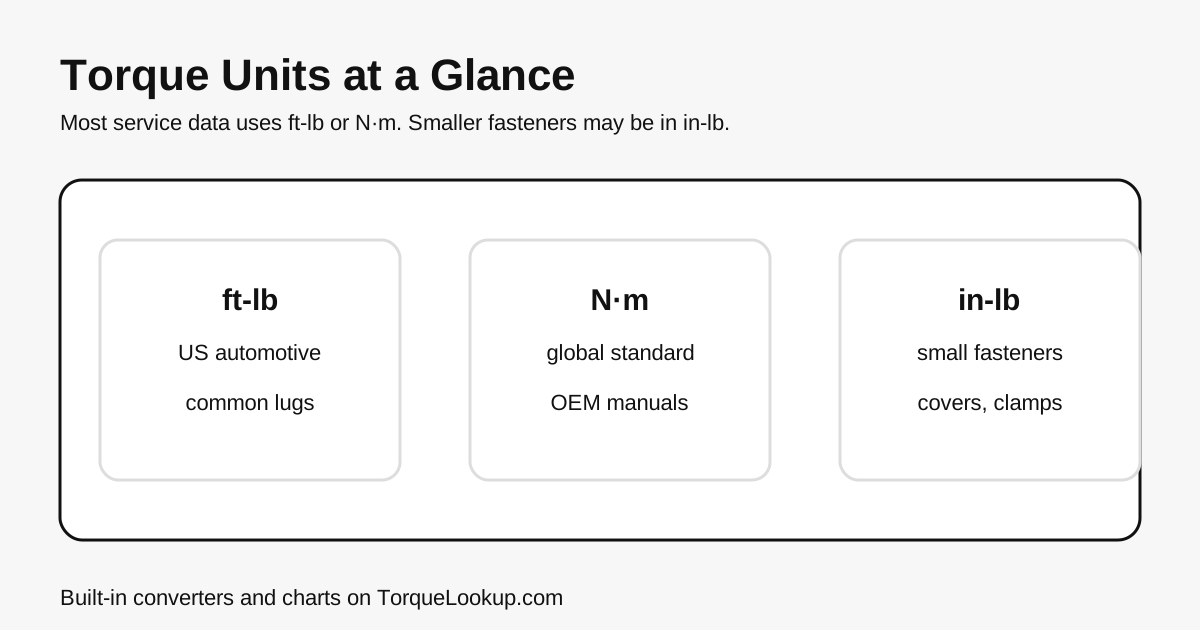
What you will find in this category
- Axle, pinch bolt, and triple clamp torque best practices for motorcycles and off-road machines.
- How small fasteners fail: over-torque, poor seating, and incorrect wrench range (in-lb vs ft-lb).
- Brake hardware guidance: clean threads, correct threadlocker, and staged tightening.
- Off-road vibration management: why clamp load and washer condition matter.
- Paths to build model-specific pages (Yamaha, Honda, KTM, Polaris, Can-Am, etc.).
How to use this page for fast, repeatable work
This category page is intentionally deep. It is built to rank for broad queries and to provide enough context that you can safely apply torque practices across a wide range of components. It is also the parent hub for future spec pages (by make/model/component) that you can add later without changing the structure of the site.
Troubleshooting torque problems in the real world
If you are seeing repeat failures—loose hardware, broken bolts, gasket leaks, vibration, or fretting—the root cause is often not “wrong torque,” but inconsistent friction, poor seating surfaces, damaged threads, or hardware that is outside specification. A torque wrench can only control the input. Clamp load is the output, and output depends on condition.
Best-practice foundations
Motorcycle and powersports torque work prioritizes joint integrity under vibration, heat cycles, and frequent service. Small fasteners are common, so tool selection and thread condition matter as much as the value itself. Many fasteners thread into aluminum; cross-threading or over-torque is a primary failure mode.
Core workflow
- Use the right range: prefer an in‑lb torque wrench for small hardware; avoid the low end of a large ft‑lb wrench.
- Seat and align: ensure bearings/spacers are seated before torquing axles, pinch bolts, and clamps.
- Follow retention rules: replace locking nuts/cotter pins, use specified threadlocker grades, and observe safety-wire requirements where applicable.
- Sequence + stages: brake rotors, triple clamps, and covers often require staged tightening and pattern-based sequences.
- After checks: verify lever feel, wheel free-spin, and re-check critical hardware after initial heat cycles when specified.
Quick reference tables
These are general reference patterns and reminders. Use exact OEM figures for final torque values.
| Component | Typical range (reference) | Critical notes |
|---|---|---|
| Control clamps | in-lb to low ft-lb | Use in-lb wrench; watch for bar rotation and clamp gap symmetry. |
| Axle pinch bolts | low to mid ft-lb | Clean threads; tighten evenly; avoid bottoming bolts in clamps. |
| Brake caliper bolts | mid ft-lb | Use OEM threadlocker spec; confirm pad/rotor clearance after torque. |
| Sprocket hardware | mid ft-lb | Confirm seating; re-check only if OEM allows; use new locking tabs if required. |
| Engine covers | in-lb | Gasket surfaces distort easily; use staged center-out tightening. |
Why do pinch bolts strip so easily?
Pinch bolts are small, often clamping on round surfaces. Overtorque or torquing with dirty threads can exceed the fastener’s yield quickly—use the right in-lb range and follow OEM sequence.
Do I torque suspension bolts with the bike in the air?
Often no. Like automotive bushings, many pivot points should be torqued at ride height (or per OEM method) to avoid bushing preload and premature wear.
Can I reuse axle nuts and cotter pins?
Follow OEM. Many axle nuts are reusable but cotter pins and certain locking hardware should be replaced.
Next steps
For immediate utility, use the converters and charts in Torque Charts & Calculators. For deeper fundamentals about lubrication, bolt grades, and clamp load, use Fasteners & Aftermarket Hardware. To expand this category into specific torque spec pages later, follow the same URL structure and link from here.