Automotive Torque Specs
Ford
Browse models & specs
Chevrolet
Browse models & specs
Dodge
Browse models & specs
Nissan
Browse models & specs
Honda
Browse models & specs
Toyota
Browse models & specs
Automotive torque specifications and best-practice procedures for wheels, brakes, suspension, engine assemblies, and drivetrain joints.
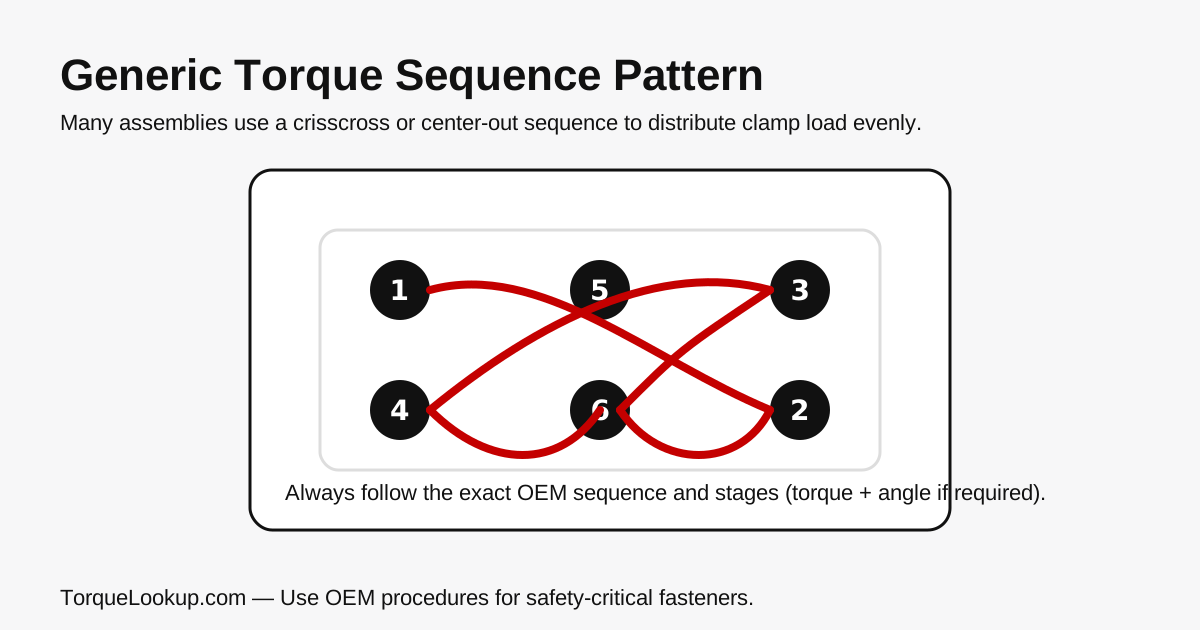
What you will find in this category
- Process-driven torque guidance for wheels, brakes, suspension, and engine work.
- What changes clamp load: lubrication, anti-seize, threadlocker, surface finish, and hardware condition.
- How to approach staged torque, crisscross sequences, and torque-to-yield fasteners.
- Tool selection guidance (ft-lb vs in-lb ranges) and calibration reminders.
- Internal linking paths to expand into make/model/year component pages later.
How to use this page for fast, repeatable work
This category page is intentionally deep. It is built to rank for broad queries and to provide enough context that you can safely apply torque practices across a wide range of components. It is also the parent hub for future spec pages (by make/model/component) that you can add later without changing the structure of the site.
Troubleshooting torque problems in the real world
If you are seeing repeat failures—loose hardware, broken bolts, gasket leaks, vibration, or fretting—the root cause is often not “wrong torque,” but inconsistent friction, poor seating surfaces, damaged threads, or hardware that is outside specification. A torque wrench can only control the input. Clamp load is the output, and output depends on condition.
Best-practice foundations
Automotive torque work is less about memorizing a single number and more about applying a repeatable procedure. A torque value is a shorthand for a target clamp load under assumed conditions—clean threads, correct seating surfaces, and consistent friction. When those assumptions change (paint, corrosion, threadlocker, anti-seize, reused hardware), the same torque can produce a very different clamp load.
Use a process: identify the exact joint and hardware, seat the joint, then torque in stages and sequence. Many assemblies also require replacement hardware (locking nuts, staked nuts, torque-to-yield bolts). Treat that requirement as part of the specification.
Core workflow
- Identify: year/trim/engine, bolt vs stud/nut, diameter/pitch, grade/class, single-use rules.
- Prepare: clean seating faces and threads; chase damaged threads; remove paint/debris.
- Friction control: follow OEM direction for dry/oiled/threadlocker. Do not swap products casually.
- Sequence + stages: bring fasteners to ~30–50% in sequence, then final torque; apply torque+angle steps with an angle gauge.
- Verify: mark completion, re-check where specified (e.g., wheel hardware), and inspect for damaged hardware.
Quick reference tables
These are general reference patterns and reminders. Use exact OEM figures for final torque values.
| Application | Typical sequence pattern | Notes |
|---|---|---|
| Wheel/lug hardware | Crisscross / star pattern | Stage torque, then final. Re-check only if OEM allows. |
| Brake caliper bracket | Alternating bolts | Clean threads; use OEM threadlocker spec if required. |
| Valve cover | Center-out / alternating | Use in-lb values; avoid overtightening gaskets. |
| Suspension linkages | Seat then torque at ride height | Many bushings must be torqued at ride height to avoid preload. |
| Axle/hub nuts | Single fastener | Often very high torque; may require staking or replacement. |
What is the most common automotive torque mistake?
Skipping seating and stages. Many failures come from torquing a joint that isn’t fully seated, or jumping directly to final torque without a staged sequence.
Should I use anti-seize on lug nuts?
Only if the manufacturer specifies it. Anti-seize changes friction and can increase clamp load at the same torque; follow OEM instructions for your exact wheel hardware.
What does torque-to-yield mean?
Torque-to-yield fasteners are designed to stretch into a controlled range and often require a torque stage followed by an angle stage; many are single-use.
Next steps
For immediate utility, use the converters and charts in Torque Charts & Calculators. For deeper fundamentals about lubrication, bolt grades, and clamp load, use Fasteners & Aftermarket Hardware. To expand this category into specific torque spec pages later, follow the same URL structure and link from here.